Showing posts with label Heritage. Show all posts

Saturday, March 8, 2014

Our Father...Who art in Washington

His name is indeed hallowed by many...whether with the little community's youth orchestra performance of Copland's "Lincoln Portrait" or in the temple where they enshrine him in Washington, his name is almost universally numbered among the prophets of history.

Lincoln taught us about fathers, and through it, Steven Spielburg has established new traditions around fatherhood.

Here is the father in the home, imperfect and arbitrary in so many ways, unreasonable and distant, even harsh in neglect and a failure to communicate coherently...yet somehow occasionally tender.  He ultimately casts a strange kind of shadow over the lives of his children.

In an article in the Washinton post entitled "The Comfort of Lincoln as Imperfect Father" Tracy Grant wrote: "Even for the Great Emancipator, parenthood was the great equalizer."

Here is the father of his nation as so many like to call him, and no one asks of him a reason for the terrible things he does, or even tries to understand the complex reasons for all his simple acts of blatant tyranny or thinly veiled dictatorship.  The reason is in himself, it would seem.  He accomplished what he was meant for ..."fit his time" as you might say and payed his dues to humanity by obliging them with their desired ends.  So we take interest in the machinations of a radical, power-hungry madman as if they were the impersonal footsteps of the march of progress through time, somehow inviolate and above the common way, "blest with divine right" as you might say.

If anyone notices the inconsistency in all this, the blatant touted inconsistency, "they do not understand".  Understand what?  That a father can wage an ungodly bloody war with other men's sons and then unabashedly withhold his own?  That a man can strive to grip the jurisdictions of almighty God in his hand and then fail to grasp the rightful jurisdiction of his own home?  Or that things which would be wicked in other men are hallowed on the score of the one whom men favor?  Can the tyrant be generous to a subject without making a mockery of justice?  Can he be forgiving to another, a respecter of persons rather than God, without spurning his victim in the dust?  God keep us from the great idolatry...self...from such unreasoning passion for our own ends.

I suppose in one sense one could, with reservations in plenty, recommend the circumspect perusal of a film that manages to elucidate some historical truth because it is not quite philosophically self conscious.  ...Or perhaps it is and we would rather not believe it to be so?

Tuesday, July 16, 2013

A Different Sort of Glorious


"There is a very important connection between the Church’s worldview and the Church’s hymns. If your  heart and mouth are filled with songs of victory, you will tend to have an eschatology of dominion; if, instead, your songs are fearful, expressing a longing for escape – or if they are weak, childish ditties – your worldview and expectations will be escapist and childish.
Historically, the basic hymnbook for the Church has been the Book of Psalms. The largest book of the Bible is the Book of Psalms, and God providentially placed it right in the middle of the Bible, so that we couldn’t miss it! Yet how many churches use the Psalms in musical worship? It is noteworthy that the Church’s abandonment of dominion eschatology coincided with the Church’s abandonment of the Psalms."

- David Chilton


Last week as we sang Psalm 63 in English metre to Thomas Tallis' familiar third mode melody, I was impressed not only by the nature of the music and its powerful words but also the nature of our assembly, gathered in a circle, singing ancient words of longing and praise for our Lord.

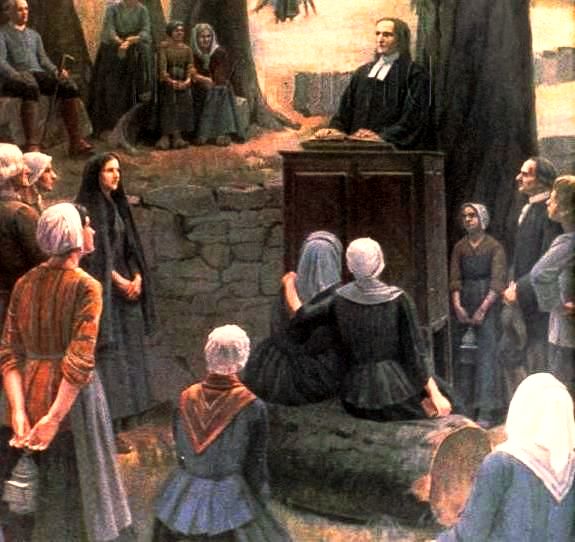
When I was little, Emily read a book aloud to me, parts of which I will never forget. The book is called St. Bartholomew's Eve (by G.A. Henty) and recounts the story of the French Huguenots, their mission and the persecution they endured throughout the 16th century. In the story, the hero hears singing in the woods and discovers a Huguenot church meeting. The Huguenots are singing hymns of praise to God and studying His word together at the risk of their own lives, since meeting outside of a state church was prohibited. The author paints such a vivid description of the scene I was convinced I had seen an illustration, even though, as far as I can tell no significant painting or drawing representing this aspect of history exists. The Huguenots are gathered in a circle, their faces uplifted, fearlessly singing. In the story, as was the case for most Huguenot gatherings historically, the city authorities discover their meeting and slaughtered them without respect for age or position. Only a few escape who were perhaps protected by men at arms or missed in the general uproar.

Generally, when we think of glorious music we imagine grand, state-sanctioned church productions of Handel’s Messiah or Kyrie Eleison or Saint Matthew’s Passion. Most American’s have grown accustomed to worship music productions so noisy they can’t even hear their own voice.

Perhaps we have forgotten a different sort of glorious, the kind that comes from impassioned believers producing imperfect but heartfelt music. Believers who have tasted persecution, counted the cost and embraced the trial before them, produce an entirely different sort of music. The average church attendee comparing our assembly last week to a grand church production complete with perfectly balanced sound and acoustic sensitivity would perhaps be dissatisfied.

But if you put on a different set of glasses you would see patriarchs earnestly seeking God’s truth with their families gathered around them, mothers holding babies in their arms who will change the world, sons and daughters embracing their family’s mission with joy and energy, families who love the kingdom of God, singing out of the conviction that the ability to worship God in sincerity and faithfulness to His Word is an immeasurable privilege. And it is glorious! The kind of glorious that relishes the battle and rejoices in the eternal victory of God.

O Lord, My God, Most Earnestly

Psalm 63

Thomas Tallis, 1567; alt.

Psalter, 1912
rev. Psalter Hymnal, 1987

O Lord, my God, most earnestly I seek Your holy face,
Within Your house again to see the glories of Your grace.
Apart from You I long and thirst and naught can satisfy;
I wander in a desert land where all the streams are dry.

The loving kindness of my God is more than life to me,
So I will praise You all my days and pray continually.
In You my soul is satisfied, my darkness turns to light,
and joyful meditations fill the watches of the night.

Beneath the shadow of Your wings I sing my joy and praise.
Your right hand is my strong support through troubled nights and days.
All those who seek my life will fall; my life is in Your hand.
God's king and people will rejoice; in victory they will stand.


Thursday, July 4, 2013

Independence Day


For the last week, we have commemorated the 150th anniversary of that great tragedy the battle of Gettysburg and for me history has rarely been more alive. Today is Independence Day ... a day of thanksgiving ... though many have forgotten exactly what it is we are to be thankful for. We visited the Pennsylvania State Capitol building in Harrisburg this afternoon. The legislature is not in session and the effect of the deserted grounds was almost chilling.


The city of Harrisburg feels rather more weighted than distinguished by the emerald-domed edifice. Even with a crowd about it, that capitol seems dead. For a moment, with the sun baking my face and my neck kinking so my eyes could scale the summit and the gold image that crowns it, the architecture transported me to stand before the crumbling ruins of Rome and Athens. "Confidence of man in man is the fundamental sanction that upholds every secure title to wealth," one inscription read. Here man has made a name for himself...and here he tears himself down with his own hands.


"He who sits in the heavens laughs; the Lord holds them in derision."


Here rubbish littered the bottom of dry fountains and so "Like a muddied spring or a polluted fountain is a righteous man who gives way before the wicked." There we crossed the street before wide stone stairs scaling the height to great carved doors and in the shadow of imposing Corinthian columns and gleaming white statuary a shiftless character sprawled unconsciously across the crumbling steps of a tumbled-down shop. Now we read an inscription beneath the honorary statue of John Frederick Hartranft, the minion of tyrants, now a vague mention of knowledge as the seat of justice over some leaf-strewn bench.


Such strange ironies are scattered over the stone and wood of this thing made with man's hands. Here a lion spews water fiercely from a drain pipe across from a door carved with images of productivity and industry. There an eagle, that flagrant emblem of aggression and coercion, perches over a gate along with the face of the god-fearing William Penn, the father of this commonwealth that is his namesake.

"Let tyrants and slaves submissively tremble
And bow down their necks neath the juggernaut car"


The capitol's stark white walls glared wearily on the grimy streets and buildings before it, almost as if were tired of housing an empty shell. It is the Fourth of July...our Independence day...and yet while the white opulent structure, supposedly the seat of the defense of justice - the state - looks vacantly out of bared doors and window sashes sporting cobwebs, a rock concert shakes its foundation from two blocks away.


Last to be paused before is a complete replica of the Liberty Bell, bound by some pragmatist advocate of certain kinds of public silence to hang still and silent, yet with the ringing words of almighty God emblazoned on it nonetheless..."proclaim liberty throughout the land to all the inhabitant thereof." I can knock on it with my hand and its voice sings...muffled like the distant tolling of a lament, echoing over the public square. One day perhaps it will ring again once more...if it is allowed to endure until that time when all things are made new. When the last stones of man's dead works are shown to be what they always were and lie crumbling in the dust before the piercing glare of the living God, we will no longer need these sobering reminders to fear and obey Him.


"Down with the eagle and up with the cross!
...Shouting the battle cry of freedom!"


“Woe to him who builds a town with blood
and founds a city on iniquity!
Behold, is it not from the LORD of hosts
that peoples labor merely for fire,
and nations weary themselves for nothing?
For the earth will be filled
with the knowledge of the glory of the LORD
as the waters cover the sea."
~Habakkuk 2:12-14

The proclamation of true freedom is certainly a battle cry.  To what end do you build this Independence Day?

Tuesday, May 28, 2013

The Renovation Diary is on Hold...


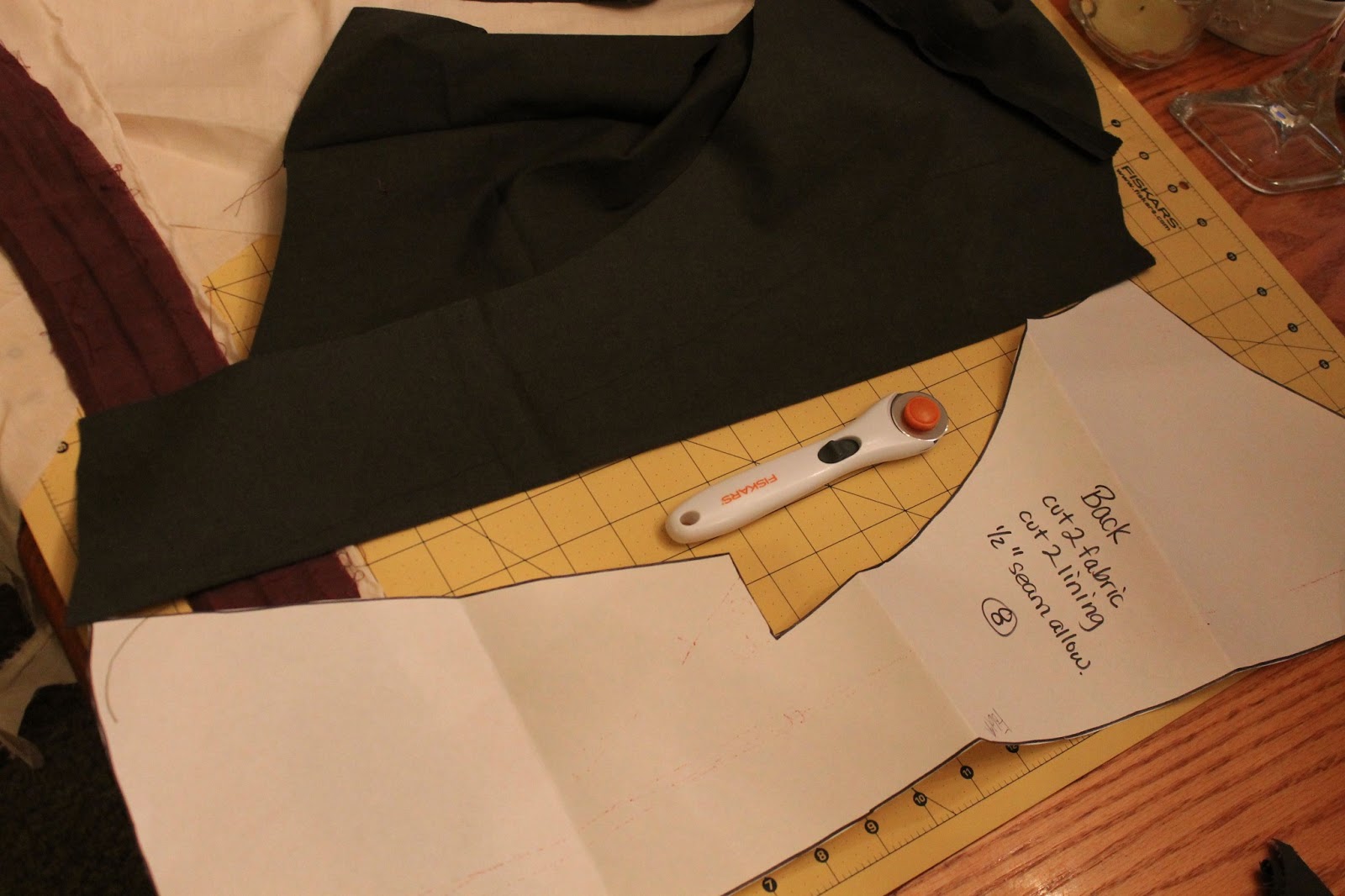
Confederate gray wool and twill, delicate white sheers, buttery unbleached muslin, rich dark mauve linen and deep olive cotton scraps litter the floor.  
"...there is no more left over in snippets than will serve to make tippets for mice"
as Miss Potter's poor Tailor of Gloucester would say.
Zuave Jackets pulled from the pattern of a riding coat...


skirts turned and re-pleated...


and soldiers trousers with signature "mule-ear" pockets have taken over sewing scene.


Saturday, December 8, 2012

Variations on What Theme?


Is Musical Taste Perception or Principle...or Both?

Musical talk these days is heated.  Likely it always has been so; but now the debate takes on the flavor of a society which is fiercely committed to humanism.  Even among Christians, the banter can become surprisingly pragmatic and presuppositionally trite and many are nearly rudderless when it comes to the principles of the matter.  Most Americans prefer to maintain the anonymity of our principles under the guise of preference.  Many of us, on one level or another, have accepted the constraints of a culture dogmatically loyal to tolerance...ultimately the worship of human wisdom.  We consistently refer to taste in musical style as an issue of personal preference.  And I suppose in one sense you could say it is.  But when did you ever hear of a preference that wasn’t born out of principle? As Christians, we should have preferences based upon that which is principally right and true.  We are required to take our preferences captive to the obedience of Christ, along with every other thought. A lawful Christian preference is perforce born out of the word of God, not our own imaginations.  We are supposed to be equipped saints, prepared for kingdom building: 
"so that we may no longer be children, tossed to and fro by the waves and carried about by every wind of doctrine, by human cunning, by craftiness in deceitful schemes."
~Ephesians 4:14
To have this kind of “preference” is an obligation...a necessary result of the indwelling of the Holy Spirit.  By this, I mean no more nor less than that, as we grow more and more into the image of Christ, the things which God loves and calls beautiful will be the definitions of our personal taste...our comprehensive aesthetic. Aesthetics and the cultivation of certain tastes are a part of our nature…a nature created to worship. Since we are worshiping creatures, the god we serve must and will dictate the manner in which we worship.  This is a chilling reality.  It brings the mirror of truth to bear on our labels and categories.

One simply cannot deny the nature of music.  It is a lucid reflection of the thoughts and emotions of man’s mind as he reflects the creative nature of Him in whose image he is created. Down to the very wavelengths of the notes, music acts obediently to its Maker.  Consequently, it cannot be other than powerful and communicative.  For this very reason, one cannot appeal to the topic’s supposed neutrality.  Granted, the music itself… that is, the notes, the tools, the function, is not the source of our definition for musical morality. There is after all nothing inherently sinful in a violin (perish the thought) or an electric guitar.  The depravity of the human heart is the source of the morality or immorality we find in music; harboring an infinite variety of wrongs which it can cause inanimate tools to express.  Since men’s hearts are desperately wicked, apart from miraculous regeneration they produce all kinds of evil…and the world of music is no exception.
"If even lifeless instruments, such as the flute or the harp, do not give distinct notes, how will anyone know what is played? And if the bugle gives an indistinct sound, who will get ready for battle? So with yourselves, if with your tongue you utter speech that is not intelligible, how will anyone know what is said? For you will be speaking into the air."
~1 Corinthians 14:7-9

This is why men like Bach are fascinating to me.  Regenerate and submitting his will to Christ, he recognized the mortal danger of taking the power and wonder of music lightly.  He is the kind of man whose music still speaks about the glory of God, even after he himself has long gone to his eternal reward.  To this day Bach exacts a kind of awe and applause from even the most nihilistic and degenerate audiences.  A kind of noblesse oblige drags the modern musical world to its feet in reluctant ovation.  Bach himself admitted to no genius, but only adherence to the rules of the created thing; which rules he uncovered through painstaking study.  Like a surgeon delving into the uncountable wonders of the human body, Bach probed with single-mindedness through a perfect creation long twisted by sin; inexorably demanding everything from it, and consequently unveiling the undeniable fingerprints of God.

Christians need to stop imagining that they are not bound to do the same as he.  When he said he was obliged to work hard, he said no more than was strictly true .  We are not given the option of neutrality any more than he was.  We are not even allowed to "do it just like Bach" because that would abrogate the principle.  Because of this, Christians tend to allow the issue to slide.  The idea of working as hard as Bach makes our flesh, well, balk!

So how does one even begin to form a right opinion on music?  It would be easier indeed to call our taste in music a preference in the neutral sense of that word.  But I believe this position denies the Lordship of Christ over this as well as every area of life.  We must begin by study; identifying the sources and purposes of each musical style and holding up every note to the mirror of God’s perfect word to judge whether it meets the standard.

There are such things as excellence and truth in music principle.  They reside first in the nature of God, and appeal to nothing and no one for their authenticity, identity, or authority.  If one cannot acknowledge His authority and comprehensive dominion of this matter, one does not even have a logical basis on which to base any kind of knowledge or opinion on the topic at all.  If we believe this, we can draw at least two conclusions about music.

First, from infancy music, like any other element of culture, has discipled us. Music teaches men a manner of thought and speech.  It formulates an attitude, and a bearing towards our fellow man; and ultimately, strongly influences the nature of our thoughts and emotions towards God.  Consider other forms of communication which can be analogous: speech, dress and carriage.  No wise man uses slang or street talk before a king.  No pure woman wears the garments of a prostitute.  No honorable soldier ambles in a slovenly gait.  No just business man hangs his head like a coward.  And no Christian brings impure, slovenly, disorderly, excessive, insolent or ungainly music into the presence of the Most High God to offer it as a sacrifice of worship with the excuse of preference, ignorance, neutrality or perception.

Secondly, music was not primarily created for our comfort or even our benefit, but for His own pleasure and glory.  Of course, in as much as we are submitting to Him, we will find His pleasure becomes our own.  However, the moment a man begins to rely on His own skill, taste, judgment and perceptions for a standard of music, so soon does he raise his own will up over the authority and pleasure of God.  Music cannot be the expression of the un-bridled human will; otherwise it becomes in every sense most vile and ugly.  Only as it reflects the divine image and will of God can it become truly beautiful and right.  In one sense, one cannot expect music to excel beyond the sanctification of the men who are using it.  It speaks the words of the heart which the mouth cannot utter.

If this little essay has hardly scratched the surface of the issue, then let it insight others to further study. I do not believe there can be such a thing as neutrality of aesthetics in music.  Its myriad diversity embodied in infinite continuity is awash with the splendor of the Most High.  Don’t let us become confused with our muddied perceptions.  The variations that exist within beauty are variations that originated in the mind of God.  So let our work in this field of God’s kingdom be variations on a Theme: the Theme of the Creator.

O be careful, little heart, of the music you make.

Wednesday, September 5, 2012

Chocolate Cake: The Final Verdict

 A few months ago, in anticipation of Ben's party, we set out to find a quintessential chocolate cake recipe. For years, we have been less than satisfied with two recipes, one simple, dry and dull and the other requiring an everlastingly long series of details for a fairly fluffy, deep chocolate, relatively moist cake.
The weekend before last, the Lenz ladies from different generations (you know who you are!) gathered around a table and savored two cakes contemplating between exquisite mouthfuls what is "quintessential" Chocolate Cake. What is the shape of the crumb? Is it small and dense or large and moist? Is chocolate supposed to be sweet or a little bitter. What is the effect of vinegar as a leavening vs. eggs?

In the end most of the ladies concluded Whacky Cake is quintessential cake but The Best Chocolate Cake was the best cake they had ever tasted. :o) If I seem to slight the gentlemen's opinion on the subject, they must acknowledge comments such as, "I like this plate because it has the larger piece" were hardly scientific.  Our reticence in regard to their opinions cannot be taken as a reflection of our estimation of their critique of food in general. :o)

To continue with our review, Whacky Cake was popular during WWII and because of it's wonderful moist texture and light sweetness it was often served with milk for breakfast! It has no eggs and is leavened with vinegar. We'll keep this one in our repertoire because it is incredibly easy to make. Often called "Cake Pan Cake", it can literally be mixed in the cake pan with a fork in a matter of minutes and is simply delicious.
On the other hand, The Best Chocolate Cake is distinctly "desert", according to our connoisseurs.  Still easy to construct, it is rich and moist, with a tastefully intense chocolate flavor and a large light crumb.
If you are bored with cake crumb, pardon the interruption from dinner reports; we'll continue with our regular broadcast next week. :o)
But not before addressing the frosting! Honestly, it was hard to properly analyze a cake covered with the most sumptuous creme you have ever tasted a half inch thick. The fact that Miracle Frosting originated in the South may have something to do with our favoring it, but not any more than its flour based thickening allowing for 1/3 of the sugar content usually required to thicken frosting. Be sure to follow the links next time you require a chocolate cake and benefit from our gracious panel of tasters!

Monday, August 27, 2012

Heritage around the table...

An abundance of food has passed through the house in the last few days along with a large company of extended relatives.


Daddy's father, Charles Lenz, passed away before any of us six Lenz children were born, so we relish any opportunity to hear about him.


His brother, Uncle John, along with around fifty cousins and aunts and uncles, came here for a family reunion on Saturday.  


The food gathered together for the day was plentiful and, of course, as varied as it was delicious.  The company was even better and stories were told and memories recalled in like abundance.  


I love the way one picture evokes a thousand memories.  Uncle John was asked to identify everyone in this photograph and as soon as he saw it, although he didn't speak all the words, you could see the day come back to him with almost more strength and vividness than yesterday's hours.  Our Grandpa Charlie was the youngest in the family...that little guy with his dog Pal in the middle.  The day the picture was taken, their mother rounded them up for hair cuts out on the drive (three of these were cousins, so no-one missed out on the fun).  As soon as Uncle John started describing, I was smelling the warm dusty summer air and hearing the laughter and the snip of the scissors...seeing the reflections of loved faces in his eyes.  There was a general burst of delighted laughter as he recalled how the dog Pal taught our Grandpa Charlie how to walk by pulling him around the house by the arm.  The gift of these memories stored up is a precious treasure of history.  For us they are a heritage of rare glimpses of the hand of God reaching into our mundane, human moments to touch them with the divine gift of meaning and continuity.  It was a privilege to read the pages of remembrance and enjoy the fellowship of family camaraderie.


Last Tuesday's meal came again out of the wonderful abundance from our garden.  Stuffed peppers with cole slaw and, yes, more beans!


In the busy rush of preparation for the family gathering, an easy and speedy recipe like this is ideal.


And yes, everything but the cheese on this plate was produced on our farm!